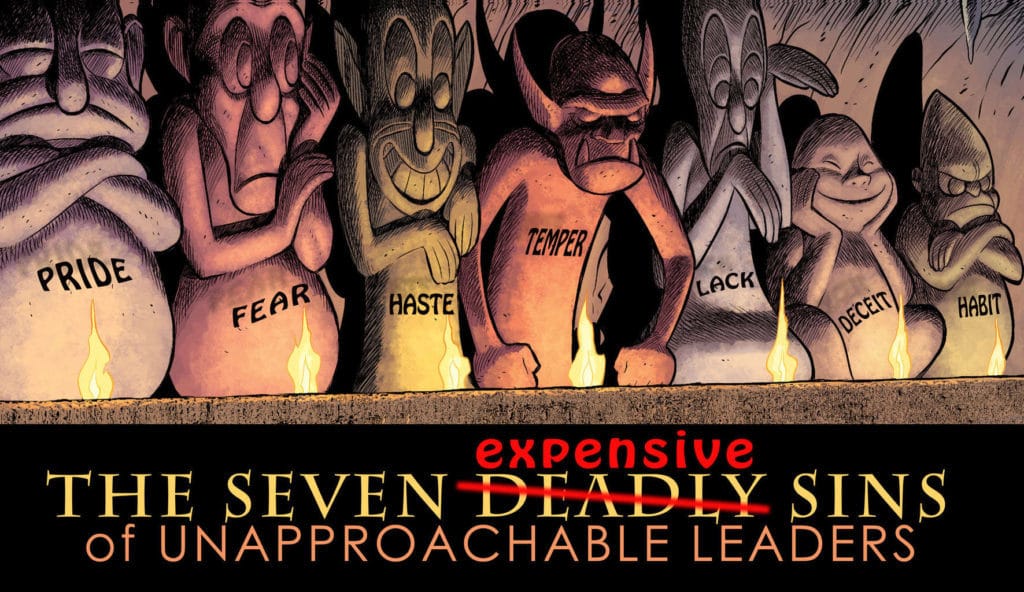
We can start with the obvious — fear and approachability just don’t mix.
The last thing any employee wants to do in a day is to approach their scary boss. And on the flip side — approaching a leader who is reacting out of fear will only reinforce for both sides the desire to avoid similar interactions in the future.
Controlling others through fear is the original sin of unapproachable leaders, and it’s one sure sign of a manager with a fairly light toolbox. Workplace bullies, villains and tyrants are superior at motivating their employees in just two respects; their victims, forced to choose between fight or flight, are well motivated to quit without warning and to sign union authorization cards. Management through intimidation is a zero-sum game in the short term and eventually everyone – management, employees and the business — loses.
A future post will delve into how even the most empathetic leaders can be (inadvertently) frightening. I’ll share some of the signs that your employees find you too intimidating to approach with confidence. (Hint: you find yourself surrounded by yes people.) And we’ll cover some ideas on what you can do about it. But first let’s look at the far more common problem – you are afraid yourself.
The Fog of Fear
 The term “fog of war” is used to describe the level of ambiguity in situational awareness experienced by soldiers in battle. While the term is open to interpretation it boils down to this; in arenas of chaos and uncertainty, it’s damn difficult to see the big picture with clarity and confidence, particularly for the boots on the ground. And in that fog of ambiguity and uncertainty, as good people overload and act impulsively, mistakes, often tragic, do happen.
Anxious workplace leaders can generate a similar “fog of fear.” And in that fog employees are conflicted, withholding, unfocused and far less likely to approach their boss until crisis is imminent. Forced to operate with conflicting (or no) information and denied the clear vision of a confident leader, employees can’t see let alone buy into the larger mission.
Our fog bound leader may be afraid for any number of reasons. He may be nervous about the future, his own or the company’s. She may be haunted by past poor judgment, or insecure about her current ability to keep up. He may see his direct reports first and foremost as competitors, or as a poor reflection on his management style. She may be in denial about the elephant in the room; he may be prone to slap a happy-faced sticky note on any and all early warning signs.
It’s normal for even the most confident leaders to have moments of fear and uncertainty. (Actually, a certain amount of self-doubt driven process checking is a very good thing.) But when a leader starts looking at the workplace through fear-fogged glasses, the haze will spread through the worksite in a hurry.
Fearful leaders react and reason defensively. Is an associate’s idea truly without merit, or merely challenging? Is there really no straight answer to a question, or is the leader just squeamish about sharing it? Is this employee truly more qualified, or just less threatening?
Back on the shop floor, when presented with escalating ambiguity, eventually even the sharpest minds shut down. Too much nonsense and we all eventually resort to autopilot for lack of a directive that makes complete sense. Great suggestions stop. Important questions don’t get asked. Problems aren’t sought out and reported. All communication becomes suspect. Trust evaporates. People just get tired and give up. And followers stop approaching their leader.
Even under the best of circumstances, it’s just not rewarding, uplifting or fun to interact with a fearful defensive boss. And you only need to shoot (or spook) the messenger once for others to think twice about bringing you bad news or a challenging new POV. And back to that big picture – in the fog of fear the unwillingness to escalate concerns and push back on bad ideas means a leader can develop an overly optimistic view of how well everything is going, and not operate in reality, until it’s too late.
Unfortunately there’s no quick fix for the fog of fear. However the solution does start somewhere – admitting you feel insecure at times and committing yourself to understand how your fears may be impacting your team. Truly fearless approachable leadership is a career-long journey. You can get started today.

I’ve been beating the drum of approachability for a few years now, and there is a lot of research that suggests this leadership behavior is critically important. So much in fact that I call approachability the “one ring” of leadership in my keynote speech.
There is an important gap in the research, however. No study has looked at approachability in a comprehensive way. Nobody has looked at these behaviors from beginning (can I tell the approachable leaders from the unapproachable ones?) to the end (do approachable leaders predictably deliver better work outcomes than the unapproachable ones?)
Until now.
Cameron Brown is working on his doctoral dissertation and decided to focus his research on approachability. It’s been fun to watch the research project evolve. He has already collected a modest amount of data (n=208) with individuals from different companies while preparing to conduct surveys with larger populations from individual companies (by the way, if your company is interested in participating in this research let me know and I’ll put you in touch with Cameron). Here is an infographic he created summarizing some of the early findings:
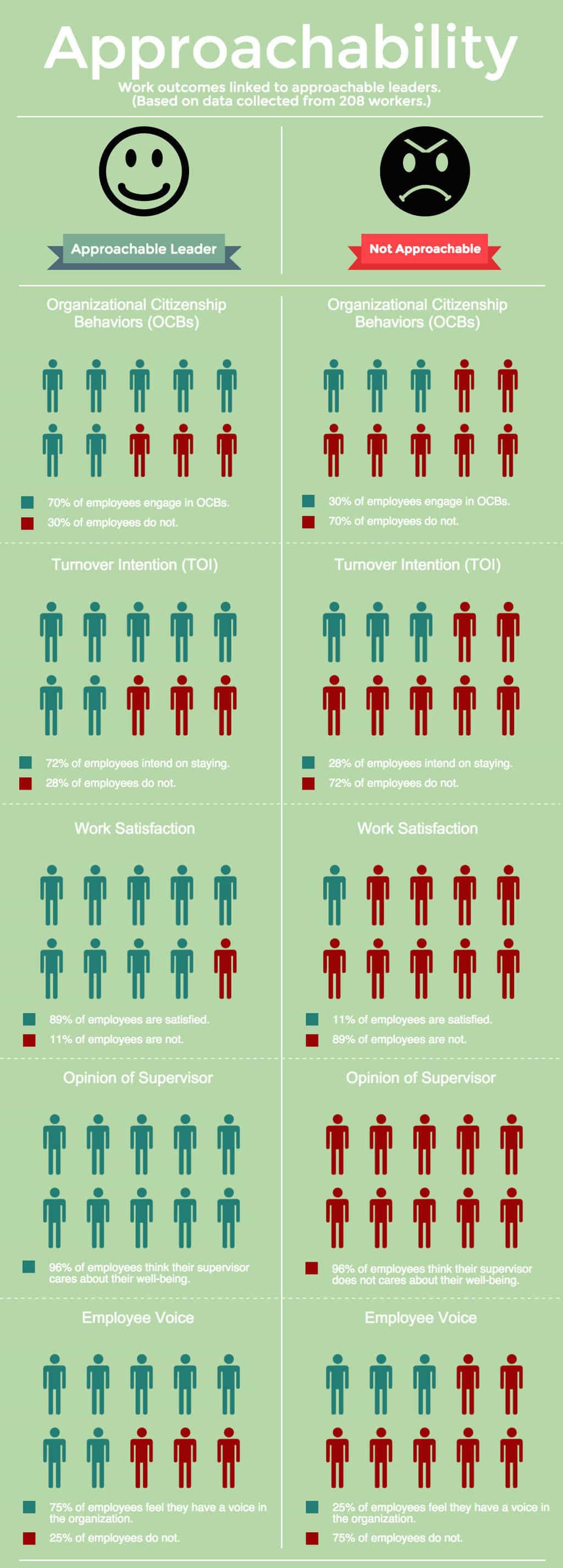
Cameron will be the first to tell you that we can’t jump to any conclusions at this point. This is a small sample. It is all “self-report” data (for example, just because someone says they engage in organizational citizenship doesn’t necessarily mean they do). These folks all work at different organizations, so that could impact the data too.
Nevertheless, these early returns are exciting. They suggest there is a strong relationship between approachability and observable business outcomes (turnover, organizational citizenship). That is something that will be tested more strongly inside companies where you can observe more than self-report data. It is also clear that unapproachable leaders are associated with some pretty negative outcomes.
Stay tuned. I’ll keep you posted as the research project continues. Please let me know if you or someone you know might be interested in letting Cameron collect data in one or more of your locations.

I ran across this quote from Tom Robbins:
“There are only two mantras, yum and yuck, mine is yum.”
Approachable leaders also choose the mantra of “yum”. They see a world of possibility and abundance, not a zero-sum world of limitation and scarcity. When they look at those they lead they think “yum” not “yuck.” For example:
- If an approachable leader notices someone struggling they think “yum” seeing this is as an opportunity to remind this individual of their great talent, help them remember overcoming obstacles in the past, and pitch in to help in any way you can. Unapproachable leaders think “yuck” and see this as a failure of someone who just doesn’t get it.
- Unapproachable leaders who see someone going above and beyond think “yuck,” hoping this go-getter isn’t showing them up or expecting some favor in return. Approachable leaders think “yum” and make sure this individual’s contribution is noticed and appreciated.
- An approachable leader sees challenges and thinks “yum,” relishing the opportunity for her team to shine. She doesn’t think “yuck,” cursing this challenge and wondering how on earth her team can possibly overcome it.
How about you? I hope you choose “yum.”

I love Simon Sinek. His TED Talks are must-watch. There is a lot about what Sinek teaches on leadership that I completely agree with (in particular the importance of creating trusting relationships versus fear-based ones). But the main prescription in his biggest book is to start with “why” and explain the reasons for your decision or to connect what your people are doing to the larger purpose of the organization. Sinek is not the only one who prescribes this. There is a whole industry of people who help companies develop vision and mission statements for organizations or teams, as if the one thing that separates the winners from the losers is the right “why” statement. If only it were that easy.
Starting with the “why” of the organization gets everything backward. The “why” of your organization or the “why” of the product launch or even the “why” of your customer is definitely something nice to know. It is way more motivating than saying, “here’s what I want you to do today – don’t ask me any more questions.” But even the loftiest mission statement isn’t what really gets people out of bed in the morning. Each of us is motivated by our own individual “why” and it isn’t something the leader explains to us. It’s something the leader discovers.
What to do instead? Start with: Do you have what you need? The assumption behind starting with “why” is that it’s the job of the leader to provide some bigger picture to motivate others. You are implying that without your explanation of the “big picture” (emphasizing your position of power) others might not be motivated to give their best. The assumption behind, “Do you have what you need?” is much more powerful. You assume others are already motivated and want to do great work. Your mission is to discover what, if anything, they need to perform the great work you know they will.
I’m not saying “why” isn’t important (Sinek offers many great examples of why it is). It may be that your direct support doesn’t understand the “why” and when you ask they will let you know. That’s when you give the “why.” But don’t start there.

 The term “fog of war” is used to describe the level of ambiguity in situational awareness experienced by soldiers in battle. While the term is open to interpretation it boils down to this; in arenas of chaos and uncertainty, it’s damn difficult to see the big picture with clarity and confidence, particularly for the boots on the ground. And in that fog of ambiguity and uncertainty, as good people overload and act impulsively, mistakes, often tragic, do happen.