Power distance killed Nokia. Not Apple, Microsoft or Android. A recent study investigates just how it happened.
It is almost impossible to believe, but the iPhone isn’t even 10 years old. If you used a cell phone before 2007 you almost certainly owned a Nokia product at some point. They were THE mobile phone company.
But Nokia is gone now. Microsoft bought them in 2013 after the company’s market value dropped by 90% over just six years. Many reasons are given for Nokia’s decline. Most observers blame the iPhone or the fact that Nokia just didn’t have the capacity to keep up.
But those stories don’t add up. Nokia was once worth $150 billion. Nokia had the creativity and the money to keep up with Apple. Nokia’s problem was cultural.
Nokia’s leaders never took Apple seriously until it was way too late. A key reason for this misstep was that mid-level managers did not feel safe confronting their leaders. There was too big a power distance gap between top leaders and other coworkers.
Power Distance in Organizations
Power distance is a concept developed by professor Geert Hofstede to help explain differences between cultures. The basic idea is that some cultures (like Eastern and Latin countries) place a high value on hierarchy and defer to power while other cultures (Western and European countries) do not.
In high power distance cultures lower power people are less likely to confront higher power ones. In lower power distance cultures people are much more willing to confront powerful people. Which brings us back to Nokia.
A recent study interviewed numerous former Nokia employees to learn what caused the company to collapse. The story told over and over by employees at all levels of the company was that top leaders mocked the iPhone. They simply refused to accept that the iPhone would ever threaten Nokia’s products.
This stance from the leaders froze the organization. Nokia became “grounded in a culture of temperamental leaders and frightened middle managers, scared of telling the truth.” In the end this refusal doomed Nokia and probably helped Apple’s product accomplish its meteoric rise.
It’s not hard to imagine. Your company is on top. Your leaders think you’re unbeatable. Competition develops. Top level managers explain away the early signs of trouble. Anybody who suggests that the competitor is a serious threat is mocked or ignored (or even fired). Nobody will buck the leaders. The pattern repeats over and over and communication goes from bad to non-existent. By the time the truth becomes clear it is too late.
This is a power distance gap. It destroys companies. This is why good leaders have a responsibility to bridge the gap. We teach leaders how to do this in our Approachable Leadership Workshop.
7 Ways to Know if You Have a Power Distance Gap
- Be on the lookout for power distance. Most leaders with a gap don’t even know it exists – they don’t take the time to notice power distance with coworkers. Step one is to look for it. If you notice power distance issues consider one or more of the tips below.
- Note your “baseline” relationship with each coworker. One way to identify a gap is to notice a change in behavior. But how will you notice a change if you don’t have a baseline? Set a baseline for each individual coworker. Some may interact with you a lot – others not much at all. Just try to notice what your “normal” relationship is like.
- Notice changes in behavior. Below are a few specifics to look for, but any change from “normal” is worth noting and bringing up. That change could be positive (shrinking the gap) or negative (widening the gap). Either way, mention what you’ve noticed to your coworker – that often leads to a very positive discussion.
- Look for evasive behaviors. Do coworkers avoid you? Do they keep at a physical distance? Do they seem reserved or indirect? Do they avoid eye contact? Do they seem uncomfortable? These are all behaviors that can signal a gap. Look for them.
- Listen for mitigated speech. Are your coworkers comfortable speaking up around you? Are they direct? Do they use declarative statements or do they beat around the bush? Are they willing to disagree? Do they stand up for themselves or do they seem to give in easily? Do they seem overly formal? These are ways to tell that someone is concerned about directly confronting someone in power.
- Create a safe space. Make sure coworkers know it is OK to disagree with you. Ask them to play devil’s advocate or to help you come up with reasons why something might not work. Role play what cold go wrong together. This helps create a more comfortable space where coworkers are more likely to speak up.
- Tell a feedback story with a happy ending. Tell a story or two about times other coworkers disagreed with you and how you appreciated and acted on that feedback. Give details that might even be a little embarrassing. This shows you are approachable, and stories often work at a much deeper level than just directly asking for feedback.
You don’t have to be someone’s best friend to be a good boss (in fact that’s a terrible idea). But you do have to make coworkers feel safe and comfortable talking to you about their concerns and dreams. Your coworkers will not talk with you if you aren’t approachable. And that’s a problem.
Just ask Nokia.
What do you think? Do you have any examples of how power distance has caused problems in your company? Have you seen major problems avoided because someone was willing to step up and confront someone in power? Let us know in the comments. Please share this article on your social networks!

Albert Saint George won the Nobel Prize in 1937 for discovering Vitamin C. He once said,
“Discovery consists of seeing what everybody has seen and thinking what nobody has thought.”
That’s a perfect description of how it came to pass that we are talking about leadership today.
We didn’t set out to become leadership gurus and it’s a fair question to ask, “what do these guys know about leadership?” Let me briefly explain how we got here:
Crucible
Our firm has helped companies solve terrible employee relations problems for 37 years – I’ve been doing it for almost 25 years. Nearly every one of these cases was brought on by a leadership failure. We learned and continue to learn about leadership in the trenches. I’ve seen a lot of terrible leaders over the years. But I’ve also been blessed to work with some amazing leaders too – and it always seems to be in the toughest conditions when you really see the best leaders shine. So this whole journey began with a simple question that we had to answer: what separates the good leaders from those who fail? This isn’t a bunch of theory about what could work, or what works when things are going great. It is based on observations of thousands of leaders under fire, and what separates the ones who come out of the crucible hard as steel from the ones who crumble.
Mission
This also isn’t some new revenue stream. Teaching people how to improve their leaders and avoid problems is not the worst way to make money – speaking from personal experience I can tell you starting a pizza restaurant is. But it’s probably a close second. I’ve watched companies fail over and over again because good people made bad leadership choices. Even after helping them through it, many of those same leaders fall right back into their old habits. Approachable Leadership developed because for 25 years I’ve searched to solve a problem: how to teach mostly blue-collar, unsophisticated managers how to become successful leaders over the long haul. This isn’t just a job for me. It’s my life’s work.
Head and Heart
I’m a lawyer and a nerd. My hobbies include playing chess and teaching debate. That means I better be able to prove something before I say it. The research behind AL is not just based on “gut instinct” or some back of the napkin theory. It is based on some incredible research. One of the crazy things about approachability is that its impact has always been out there hiding in plain sight. What we’ve done is identify and name the behavior, then helped connect the dots between what has been studied before. Like St. George says, we saw what others have seen for years but saw it in a different way. Approachability is just now getting studied in its own right, and the results are nothing short of astounding. Being approachable may sound like a “soft skill” and it is, but the research on its impact both at work and in life is as hard as it gets.
We know there’s a lot of great leadership advice out there already – 5 Dysfunctions, 7 Habits, Crucial Conversations, Situational Leadership, Start with Why. So why doesn’t it stick? Well, it’s a lot like saying I know how to swing a golf club, why aren’t I a scratch golfer?
Let’s face it, most leaders know what they are supposed to do. But when you get into the heat of battle a lot of times you end up falling back into bad habits. The more you do to complicate things the more likely you are to abandon it early. Like the esteemed management thinker Mike Tyson once said:
“Everybody has a plan until they get punched in the mouth.”
Just like that perfect driving range golf swing falls apart when you are a few holes away from your best golf round, great leadership advice tends to fall apart under the pressure cooker of today’s workplace.
That’s the problem with all these other great resources (and I do mean great – I think there is value in all of them). But there is something fundamental underneath all of these different leadership trainings that, if missing, makes all the best plans crumble when the pressure is on. If your leaders aren’t approachable – if there is a power distance gap – you won’t ever overcome the dysfunctions of a team or have a crucial or fierce conversation. You can be emotionally intelligent, understand your situation and start with why and STILL fail as a leader.
You have to get approachability right first. It is THE leadership fundamental.

Some engagement efforts don’t go as planned.
You mean well. You conduct your employee survey or focus group sessions. You collect all the data, review all the spreadsheets. You invest a lot of time, energy (and money) on your engagement efforts. And then they fall flat on their face. Ouch.
You do the right things, check the right boxes. But employee morale remains in the tank. Often the explanation is simple. Even if your heart is in the right place, you might be forgetting to walk the talk. If there is a gap between what you say and do for employees, you’re toast.
We are currently neck deep in one of the best examples of saying-doing gaps you can find – the US presidential primaries. As crazy as this year’s election season has been, are the promises that different from 2012? Are they that different from 2008? Or 2004?
Every candidate in every election promises to fix healthcare and jobs. To take care of immigration and national security. But we have made zero headway. This is what explains the surprising campaigns of Bernie Sanders (a Socialist trouncing a Clinton?) and Donald Trump (a reality TV star trouncing a Bush?)
People seem ready to push the reset button on our politics. We are sick of agreeing on the problem but then running in place. We are sick of promises with no follow through.
The same thing happens in companies. We’ve heard about the engagement gap with employees for decades. We all agree that engagement is important. It reduces turnover. It improves company culture and business results. But like our national politics, we seem to be standing still. Why? Lack of follow through.
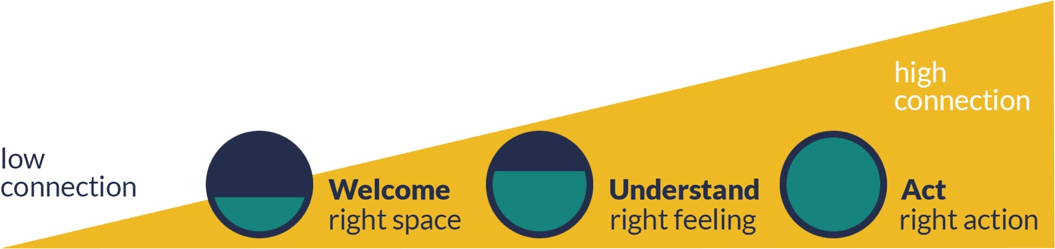
This is one of the key points of Approachable Leadership. Our model is based on 3 fundamental behaviors.
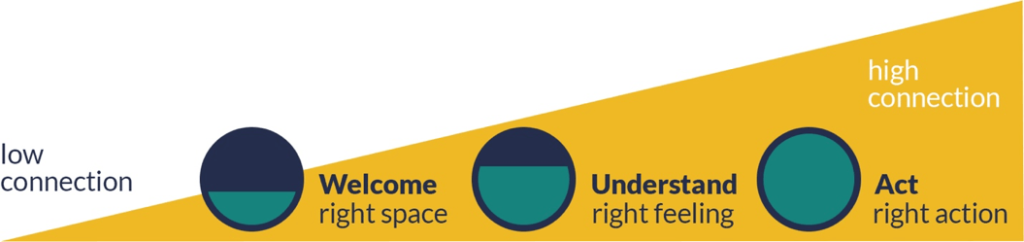
The first are welcoming behaviors. You have to create the right space where employees feel comfortable and safe. If you don’t get this right your engagement efforts stop in their tracks.
Next, leaders have to achieve understanding. They must treat employees with empathy and make them feel understood. Employees should feel better when they leave a conversation with their leader, not worse.
Finally – and most important – leaders must take what I call “right action.” Even leaders with the best intentions often stumble on this critical last step. Real engagement is about follow through – taking what you learned from the first two steps and putting it to work.
Action is what validates the rest of the conversation. Lack of follow through destroys any credibility you build in the first two steps.
A recent study examines this “pseudo voice” problem. Pseudo voice refers to a leader who asks what you think but then doesn’t do anything with it. This behavior destroys credibility. Specifically, the study found that:
negative consequences are particularly likely to occur when employees perceive the opportunity to voice opinions to be ‘pseudo voice’ –– voice opportunity given by managers who do not have the intention to actually consider employee input (i.e. managerial disregard).
The researchers saw that employees of “pseudo voice” leaders are 61% less likely to give feedback in their organization. More troubling, employees of these leaders are 65% more likely to have conflict with coworkers. On the flip side, when done right:
the positive effects associated with offering voice opportunity are well documented and include increased feelings of fairness, trust, decision control, inclusion in the group, and respect.
A welcoming and understanding leader can fool people for a while. But it’s not enough to be warm and available. You have to prove through your actions that you really are receptive to employee feedback and ideas. You have to take action. Otherwise you just push employees away and create conflict at work.
Have you ever experienced a saying-doing gap with a leader? Do you ever struggle with follow up or follow through? Use one of the links below to share your experiences with us on LinkedIn, Twitter, and Facebook.

Everybody knows bad leadership can be costly.
It leads to turnover, workplace stress, and decreased cooperation which costs US businesses billions each year. But can bad leadership kill you?
This week, the Wall Street Journal reported that United Airlines is calling in all 12,000 of its pilots for extra safety training over the next 3 months. This is due to a series of serious safety incidents. None of the incidents led to an accident, but there were several close calls.
One of the key components of the training is increased teamwork on the flight deck. One of the stated goals is to “encourage veteran captains to more-effectively mentor co-pilots, and to help junior aviators be more assertive with senior captains if they spot problems or dangers.” The training is also intended to improve situational awareness and “bridge” the generation gap.
United is focusing on exactly the right place if it wants to improve safety on its planes. More important, they are likely to see numerous other business benefits.
Anyone who has seen my leadership keynote or workshop knows I talk a lot about plane crashes. We listen in on the final conversation between the co-pilot Roger Pettit and captain Larry Wheaton on Air Florida Flight 90, which crashed in the icy Potomac River in 1982 killing 78 people. Listening to that conversation is chilling, not just because you hear the crash, but you see it was completely avoidable. The relationship between the first officer and the captain was the problem.
The reason I play that conversation is to illustrate the life or death consequences that are possible if there is a gap between leaders and those they lead. There are a lot of reasons for these gaps. Malcolm Gladwell, in his book Outliers, talks about cultural power-distance gaps (Asian and Latin cultures tend to avoid confrontation with power more than people from Western European cultures, for example) and how they contribute to plane crashes and near-miss accidents. United Airlines is focusing mostly on generational differences.
Listening in on the Air Florida flight recording illustrates how these gaps show up in subtle ways, and how important it is for both the leader and follower to take steps to shrink that gap. In that conversation the co-pilot Pettit (who was “on stick” and in charge of the takeoff) suggests to captain Wheaton that he sees a problem. But Pettit is not direct (“I don’t think that’s right”). Captain Wheaton dismisses him and Pettit briefly tries to make his point a second time. But then he backs down (“Aww, maybe it is.”) This fatal decision cost both pilots their lives (along with 76 other souls).
Why wasn’t Pettit more forceful? Why did he back down? Why did Wheaton dismiss Pettit? After all, neither one of these men wanted to die in a plane crash that day. The reason they did was because of the gap between the high powered captain and the lower powered co-pilot. Pettit used what is called “mitigated speech” when he noticed that the pressure readings were out of whack and that the plane might not be going fast enough to take off. When Wheaton dismissed him without trying to learn more Pettit questioned himself. After his second, even less forceful attempt to get his leader’s attention he feebly gave up. Seconds later they were both dead.
The gap between Pettit and Wheaton exists in nearly every power relationship. There are two ways to shrink that gap. The leader in the higher power position must be as approachable as possible. The person in the lower power position then must accept the offer and make the approach. It’s a two-way street. But the leader behavior is typically the key.
As a frequent passenger on airplanes I am glad to see United Airlines take this important step to reduce power-distance gaps in its own cockpits. They are focusing on exactly the right thing: approachability. But I predict they will enjoy substantially more benefits than just improved safety experience. Approachable leaders create many other positive changes in organizations, from reduced turnover to increased enthusiasm and organizational citizenship.
Now it’s your turn. Have you ever seen a safety problem caused by a power distance gap? Do you ever notice people afraid to confront their leader? What steps have you taken to “shrink the gap” and encourage someone to speak up about safety or any other issue? Please comment on LinkedIn or Twitter.

“Training pays.”
Seth Godin says this in his recent article on “the infinite return on investment” of talent development and training. He provides this example:
Imagine a customer service rep. Fully costed out, it might cost $5 for this person to service a single customer by phone. An untrained rep doesn’t understand the product, or how to engage, or hasn’t been brought up to speed on your systems. As a result, the value delivered in the call is precisely zero (in fact it’s negative, because you’ve disappointed your customer).
On the other hand, the trained rep easily delivers $30 of brand value to the customer, at a cost, as stated, of $5. So, instead of zero value, there’s a profit to the brand of $25. A comparative ROI of infinity.
And of course, the untrained person doesn’t fall into this trap once. Instead, it happens over and over, many times a day.
I believe this comparative ROI is exponentially greater when you talk about leadership talent development (I know, I know, you can’t have an ROI better than infinity, but I went to law school so cut me some slack). The customer service agent most often handles a customer experience just once or at most a few times in their life cycle. A leader handles the employment experience over and over again with each individual they lead. Being a little better leader pays off again and again.
Why then, do we choose to invest so little (if anything) in the talent development of our leaders?
I hear a lot of answers. Most common is the expense. Not just the cost of training (hard costs and lost time), but those dollars are competing with a lot of other business needs. Others complain they’ve been burned doing training that didn’t “stick” with supervisors. Some fear that once you train someone they might walk out the door, causing you to lose the whole investment.
Godin’s response is the same as mine: consider the alternative. “What’s the danger of NOT training the people who stay?”
You must invest in your leaders if you want your organization to grow, if you want to provide quality employment experience (not to mention a quality customer service experience). Do you want to be successful and, yes, profitable? You better be developing your leaders.
The ROI of Talent Development
The question isn’t whether to invest in developing leaders. The question is how to ensure that investment gets the highest return possible, and that it stays in the company. We humbly submit that your best bet is investing in developing approachable leaders.
Recent research has shown that employees of approachable leaders are 72% less likely to quit their jobs.
Seth Godin and us aren’t the only ones who know the value of training. The Association for Talent Development’s annual State of the Industry Report shows that the number of organizations investing in talent development has increased two years in a row.
Here are a few other statistics from the hundreds of companies that contributed to the report:
- $1,229 – the average direct learning expenditure per employee annually;
- 32 – the average hours each employee spent in training annually;
- 13% – the portion of all training that was spent on Management and Supervisors;
Let’s say you are a 200 employee location with 20 supervisors. This means if you want to be average you will spend around $32,000 per year developing those leaders (you are spending that much, right?)
This ATD report also explains that 25% of companies outsource their talent development, and most of those ask a live facilitator/consultant come in to do the training.
Here is some good news. Four days of delivering our Approachable Leadership Learning System (the Workshop plus follow-up modules) is a significantly lower investment than the average company described above. Not only that, the training sticks. It is practical and simple to understand and apply. It gets proven results (if you haven’t already, grab our eBook on The ROI of Approachable Leaders to see all the numbers).
I recognize that with $30 per barrel of oil a lot of companies are cutting everywhere they can. But just last week I trained the Approachable Leadership workshop to groups of leaders at two different companies. Each has faced huge cutbacks due to the historic drop in energy prices. These companies are doubling down on their leaders during the down time and I guarantee they will be miles ahead of those who are trying to cut their way to success.
I am obviously an avid supporter of training and talent development, and I am biased about ours. There are a lot of great leadership development options out there. The key point is to explore the options and then invest in the one that is right for your company. But whatever you do, make the investment. The ROI might not be infinite, but it is huge.
What has your experience been with developing leaders? Do you have any stories of small leader investments that paid off big dividends? What are some of the things you have tried to make sure that training sticks and has a solid return? Please share your experiences with us on Twitter or LinkedIn. Be sure to #ApproachableLeadership